

Introduction
In an era where speed, specialization, and scalability drive competitive advantage, companies are rethinking how they build and manage teams. Traditional hiring methods often fall short when businesses need to scale quickly or plug skill gaps for short-term or specialized projects.
This is where staff augmentation comes in, a strategic workforce model that temporarily allows organizations to add skilled professionals to their existing teams. Whether you’re a startup ramping up product development or an enterprise undergoing digital transformation, staff augmentation offers a flexible, cost-effective solution to meet fluctuating talent needs.
This article explains staff augmentation, explores different models and services, highlights the benefits and risks, and introduces you to top companies that can help you implement it effectively.
What Is Staff Augmentation?
Staff augmentation is a flexible outsourcing strategy that enables businesses to hire skilled professionals on a temporary or project-specific basis. Instead of hiring full-time employees, companies augment their existing teams with external talent to fill gaps, meet deadlines, or scale operations efficiently.
Staff augmentation bridges the gap between your company’s capabilities and the required skills to complete specific tasks or projects.
Why Staff Augmentation Matters Today
With the rise of remote work, global talent mobility, and increasingly complex tech requirements, staff augmentation has become more than just a trend it’s a strategic imperative.
Key Benefits Include
- Faster hiring cycles
- Cost-effective scaling
- Access to a global talent pool
- Reduced training time
- Enhanced flexibility in workforce management
Staff Augmentation vs. Other Outsourcing Models
It’s essential to differentiate staff augmentation from other workforce models like project outsourcing and managed services.
| Feature | Staff Augmentation | Project Outsourcing | Managed Services |
| Control Over Team | High | Low | Medium |
| Integration with Internal Team | Seamless | Independent | Partial |
| Billing Model | Time-based (hourly/monthly) | Fixed-price or milestone-based | Subscription or retainer |
| Use Case | Skill gaps, urgent needs | End-to-end project ownership | Ongoing support operations |
Models of Staff Augmentation
Depending on a company’s requirements, staff augmentation can take several forms. Here are the main models:
Commodity-Based Augmentation
This model focuses on hiring basic-level workers who don’t require specialized skills—for example, manual labor or simple administrative tasks.
Skill-Based Augmentation
This involves hiring professionals with specific skill sets, such as data entry specialists, clerks, or technical support agents.
Highly Skilled Augmentation
Companies hire advanced experts like software engineers, data scientists, cybersecurity specialists, or cloud architects in this model.
Onshore, Nearshore, and Offshore Augmentation
- Onshore: Augmented staff from the same country
- Nearshore: Professionals from neighboring or nearby countries
- Offshore: Talent hired from distant regions like Asia or Eastern Europe
Common Services in Staff Augmentation
The services offered under staff augmentation vary based on industry and project needs. Here are some of the most commonly augmented roles:
IT & Software Development
- Frontend and Backend Developers
- QA Engineers
- DevOps Engineers
- Mobile App Developers
- Cloud Engineers
Data & Analytics
- Data Scientists
- Business Analysts
- Data Engineers
- Machine Learning Experts
Creative & Marketing
- UI/UX Designers
- Graphic Designers
- Content Writers
- SEO & Social Media Experts
Project Management & Support
- Project Managers
- Scrum Masters
- Technical Support Agents
- Product Owners
How Staff Augmentation Works: Step-by-Step
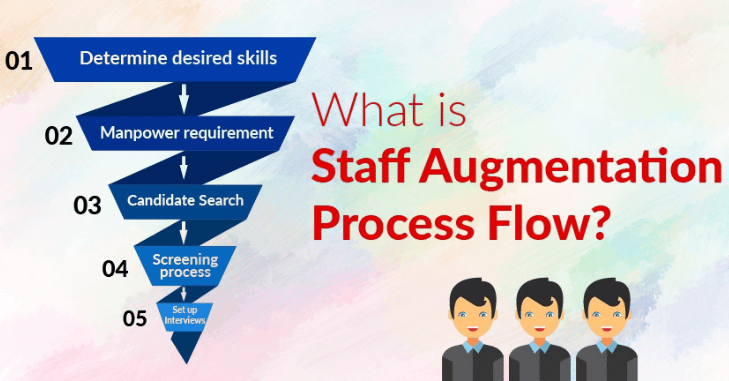
Step 1: Define the Requirement
The business identifies skill gaps, project timelines, and budget constraints.
Step 2: Choose a Staff Augmentation Partner
A vendor or platform is selected to provide access to vetted professionals.
Step 3: Screen and Select Talent
The company may interview and shortlist candidates or rely on the partner’s recommendations.
Step 4: Onboard and Integrate
Augmented staff are onboarded and integrated with in-house teams using internal tools, workflows, and communication channels.
Step 5: Manage and Evaluate
Performance is managed in real time with regular feedback and performance reviews.
Best Practices for Successful Staff Augmentation
To achieve the best results from staff augmentation, organizations should establish clear project goals, define each team member’s responsibilities, and create effective communication channels before external professionals begin work. A structured onboarding process, along with access to the necessary tools and documentation, helps augmented staff integrate quickly and contribute without unnecessary delays. Clear expectations from the start reduce confusion and improve overall productivity.
Ongoing collaboration is equally important throughout the project. Regular progress meetings, constructive feedback, and transparent communication keep both internal and augmented team members aligned with project objectives. Encouraging teamwork and sharing knowledge across the entire team not only improves efficiency but also helps deliver higher-quality results while ensuring projects stay on schedule.
Advantages of Staff Augmentation
Cost Savings
Investments in full-time salaries, benefits, or long onboarding processes are unnecessary. Companies only pay for the time the external talent works.
Scalability and Flexibility
Scale teams up or down based on project requirements without affecting core employees.
Faster Time-to-Market
Augmented staff can hit the ground running, reducing project delays and speeding up delivery.
Access to Global Talent
Tap into specialized skills unavailable locally, especially in blockchain, AI, and cybersecurity fields.
Risk Mitigation
Reduce risk by evaluating professionals temporarily before offering long-term contracts.
Disadvantages and Risks
While staff augmentation has numerous benefits, it comes with a few challenges:
- Communication Barriers: Especially in offshore models
- Cultural Misalignment: Different work ethics and practices
- Security Risks: Handling sensitive data
- Dependency Risk: Relying too much on augmented staff may hinder internal development
To minimize these, it’s essential to
- Use NDAs and secure access protocols
- Provide clear communication guidelines
- Ensure alignment on project goals and values
Use Cases for Staff Augmentation
Tech Startups Scaling Rapidly
Startups can scale quickly without the overhead of full-time hiring.
Enterprises Needing Specialized Talent
When new technologies like AI or machine learning are adopted.
Seasonal Demand
Retailers hire extra developers and marketers during holiday campaigns.
Digital Transformation Projects
Augmenting IT teams to support new platform rollouts or migrations.
Top Companies Offering Staff Augmentation Services
Here are some of the most reliable companies known for staff augmentation services:
| Company Name | Headquarters | Specialization |
| Toptal | USA | Elite software developers |
| Andela | USA | Remote African tech talent |
| EPAM Systems | USA | Enterprise IT & custom dev |
| Upwork | USA | Freelancers & short-term hires |
| Daxx | Netherlands | Offshore software engineers |
| Accenture | Ireland | Full-scale IT staffing & consulting |
| TEKsystems | USA | IT staff augmentation |
| Brainhub | Poland | Agile product teams |
Choosing the Right Staff Augmentation Partner

When selecting a staff augmentation partner, evaluating several key factors is essential to ensure a successful collaboration. First, consider the talent quality by assessing how thoroughly the company vets and selects professionals. This will help ensure you’re working with highly skilled and reliable individuals.
Next, evaluate the vendor’s scalability and determine whether they can quickly provide additional resources as your needs evolve. It’s also important to check the communication tools they support, such as Slack, Zoom, or Jira, to ensure smooth integration with your existing workflows.
Compliance and contracts should be clear and legally sound, offering your business adequate protection and outlining responsibilities. Finally, look at client testimonials to gauge the vendor’s track record and experience with businesses similar to yours. These factors collectively help identify a trustworthy and capable staff augmentation partner.
Staff Augmentation in 2025 and Beyond
Staff augmentation will play an increasingly critical role as businesses prioritize speed, innovation, and digital agility. AI-driven platforms are beginning to match companies with talent based on deep learning algorithms, reducing the time needed for screening and hiring. Additionally, augmented reality (AR) and VR onboarding may make integrating remote workers faster and more immersive.
Final Thoughts
In conclusion, staff augmentation is a dynamic and forward-thinking staffing solution that empowers organizations to adapt quickly in a constantly evolving business environment. By leveraging external talent on a temporary or project-specific basis, companies can bridge skill gaps, accelerate project timelines, and enhance operational efficiency without the long-term commitment of full-time hiring.
From understanding various augmentation models to exploring industry-leading service providers, this guide offers a thorough foundation for leveraging staff augmentation effectively. As workforce demands shift and digital innovation accelerates, adopting a strategic staff augmentation approach can provide the flexibility, speed, and expertise needed to maintain a competitive edge in 2025 and beyond.
Want to know about “5 Must-Have Business Travel Hacks for Busy Executives” Check out our “Business” category.
FAQs
One adaptable outsourcing tactic that aids companies in hiring the expertise they require is staff augmentation.
Through the outsourcing technique known as “team augmentation,” a business temporarily and contractually adds outside talent to its current software development team.
While consultancy offers strategic guidance for complicated problems like digital transformation, staff augmentation addresses short-term needs with specialized skill sets, such as new feature development.
Simply put, it is an outsourcing arrangement that allows businesses to temporarily hire IT personnel to meet project requirements or skill gaps.
Whether you’re a startup ramping up product development or an enterprise undergoing digital transformation, staff augmentation offers a flexible, cost-effective solution to meet fluctuating talent needs. Learn more about advanced marketing analytics can help you make informed decisions regarding your staff augmentation strategy.
Whether you’re a startup ramping up product development or an enterprise undergoing digital transformation, staff augmentation offers a flexible, cost-effective solution to meet fluctuating talent needs. Learn more about temporary hiring strategies for legal services