
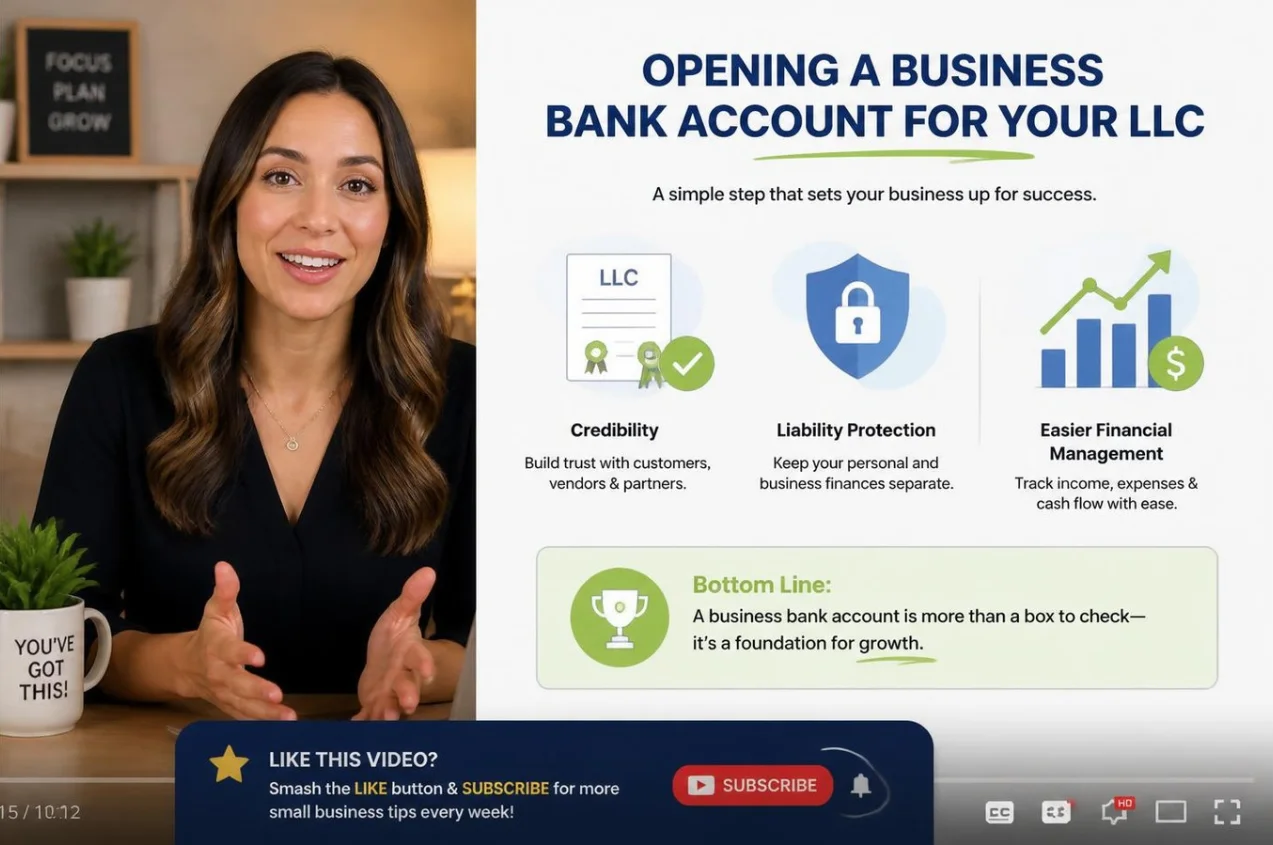
Opening a dedicated account is an important task after forming your limited liability company. Learning how to open a business bank account for an LLC can also prevent avoidable application delays. You’ll generally need your formation documents, tax information, identification, and basic details about your company.
Quick answer: To open an LLC bank account, choose a suitable bank and gather your required business documents. You’ll typically need your EIN, Articles of Organization, operating agreement, and government-issued identification. Complete the bank’s application, verify ownership details, fund the account if required, and then move business transactions into it.
| What you’ll need | Typical requirement |
| LLC formation document | Articles of Organization, Certificate of Formation, or equivalent |
| Federal tax information | EIN and, when requested, IRS confirmation |
| Ownership document | LLC operating agreement |
| Personal identification | Driver’s license, passport, or another accepted government ID |
| Business information | Legal name, address, industry, and formation date |
| DBA documentation | Required when applicable |
| Opening deposit | Depends on the bank and account |
| Application method | Online, in person, or both |
How to Open a Business Bank Account for an LLC

Keeping company money separate makes bookkeeping and financial management easier. It also creates clearer records of business income, expenses, transfers, and owner contributions. Those records can become valuable when preparing taxes or reviewing company performance.
Financial separation is an important part of How to Open a Business Bank Account for an LLC because it helps maintain a clear distinction between the company and its owners. A dedicated business account gives your LLC a clearer financial identity from the start. Marketeral’s guide to business banking and other startup resources also shows how banking can fit into broader financial planning for a new organization.
Using one account for personal and company spending creates unnecessary accounting work. You may need to classify mixed transactions later and locate missing records. A dedicated account gives your company a cleaner financial starting point.
What Do You Need to Open an LLC Bank Account?
Exact requirements differ among financial institutions and individual applications. Checking the bank’s document list before applying can save time. Most LLC owners should prepare several core records.
Common requirements typically include the following documents and details.
- Articles of Organization or another state-approved formation document.
- Employer Identification Number, commonly called an EIN.
- EIN confirmation or verification documentation when requested.
- LLC operating agreement.
- Government-issued identification for authorized signers.
- Legal company name and business address.
- Formation date and state of organization.
- Business phone number and email address.
- Industry and expected account activity.
- DBA or assumed-name certificate, when applicable.
- Business license, when required.
- Information about owners or controlling individuals.
Banks must verify customers and may request additional ownership information. Requirements can also differ for foreign owners and unusual ownership structures. Ask your chosen institution for its current checklist before submitting the application.
How to Open a Business Bank Account for LLC Operations
The process becomes easier when you prepare before starting the application. Your LLC should already be properly formed with its state. Then follow these steps in order.
1. Finish Forming Your LLC
Complete your state formation process before applying for an account. Your approved formation document proves the company legally exists. Its exact name varies between states.
Check every detail on the approved document before continuing. Your company name should match the information used throughout the banking application. Even small inconsistencies can trigger requests for clarification.
2. Get an EIN from the IRS
An Employer Identification Number is a federal tax identification number for businesses. The IRS issues EINs directly, and eligible applicants can obtain one without paying an application fee. Many financial institutions request an EIN when opening an LLC account.
Certain single-member LLCs may not need an EIN for federal tax purposes. The IRS notes that an LLC can still obtain one when a bank requires it. Getting an EIN can also simplify company identification across financial records.
Apply directly through the IRS rather than paying unnecessary third-party filing charges. Save your confirmation information after receiving the number. Your bank may request documentation verifying the EIN.
3. Gather Your LLC Documents
Prepare your paperwork before beginning an online or branch application. Keep digital copies available if you plan to apply online. Clear and current documents can reduce back-and-forth during verification.
Your Articles of Organization and operating agreement are especially useful. The operating agreement can show ownership and management arrangements. Some institutions may also request licenses, DBA records, or additional state documentation.
4. Compare Business Checking Accounts
Don’t select an account based only on a familiar bank name. Compare costs and features against how your company will use the account. A freelancer may have different needs than a retailer handling daily cash deposits.
Review the following account factors carefully.
- Monthly maintenance fees.
- Minimum balance requirements.
- Opening deposit requirements.
- Transaction limits.
- Cash deposit options.
- ACH transfer capabilities.
- Domestic and international wire fees.
- ATM access.
- Mobile deposit limits.
- Accounting software integrations.
- Customer support.
- Savings options.
- Deposit insurance status.
Pay particular attention to fees your company will encounter regularly. A low monthly fee may mean little if common transactions cost more. Choose features based on expected activity instead of promotional offers.
5. Confirm Deposit Insurance
Check whether your chosen bank is insured by the Federal Deposit Insurance Corporation. Eligible deposit accounts at FDIC-insured banks receive automatic insurance within applicable limits. The FDIC currently sets standard coverage at $250,000 per depositor, per insured bank, per ownership category.
Not every financial product receives FDIC coverage. Some financial technology companies also provide banking services through partner banks. Review where deposits are held and how applicable insurance works before transferring substantial funds. You might also like How Construction Insurance Protects Your Business and Bottom Line.
6. Submit Your Application
Many institutions let LLC owners apply online. Others require an in-person visit for certain ownership structures or circumstances. Complete every requested field accurately and consistently.
Expect questions about your business activities and expected transactions. The institution may ask about revenue, transfer volumes, cash deposits, or company ownership. Answer based on current information and reasonable estimates when estimates are requested.
7. Complete Identity and Ownership Verification
The bank will need to verify the people connected with the account. Authorized signers should have acceptable identification ready. Additional information may be required concerning owners and controlling individuals.
Verification requirements can vary based on company structure and the institution’s procedures. Multi-member companies may need more documentation than straightforward single-member structures. International ownership can also create extra identification requirements.
8. Fund and Configure the Account
Make an opening deposit if your chosen account requires one. Then configure online banking, alerts, permissions, and other security settings. Enable multifactor authentication whenever the bank provides it.
Connect appropriate bookkeeping and payment tools after the account becomes active. Update invoices and payment instructions with the correct company information. Keep personal payment methods separate from ongoing company activity.
Online Bank vs. Traditional Bank for an LLC
Both approaches can work well for U.S. companies. Your decision should depend on transaction patterns and support needs. Comparing the differences makes the choice easier.
| Feature | Online-focused account | Traditional bank |
| Application | Often fully online | Online or branch |
| Branch access | Limited or unavailable | Usually available |
| Cash deposits | May be restricted | Often easier |
| Digital tools | Often a major focus | Varies |
| Face-to-face support | Usually unavailable | Commonly available |
| Fees | Can be lower | Varies by account |
| Best suited for | Digital businesses and remote teams | Cash-heavy or branch-dependent businesses |
An online-focused option may suit consultants, agencies, and ecommerce companies. A traditional institution can make more sense for businesses receiving substantial cash. Compare actual account terms before choosing either model.
Common LLC Banking Mistakes to Avoid
Using personal and company accounts interchangeably is a common problem. It complicates bookkeeping and makes financial records harder to understand. Start with clear separation rather than fixing mixed records later.
Another mistake is applying before gathering required documents. Missing formation records or identification can slow verification. Reviewing the institution’s current checklist takes only a few minutes.
Owners sometimes focus on introductory offers while ignoring recurring costs. Wire fees, transaction limits, cash deposit charges, and minimum balances can matter more. Estimate your normal monthly activity before selecting an account.
You should also avoid assuming every financial platform is itself an FDIC-insured bank. Check the institution and applicable deposit arrangement directly. The FDIC provides tools for confirming whether a bank is insured.
How Long Does Opening an LLC Bank Account Take?
Processing time depends on the institution and your company structure. Straightforward applications may move quickly after identity and document verification. More complex applications can require additional review.
You can reduce delays by keeping your information consistent across documents. Prepare identification and formation records before applying. Respond promptly if the institution requests additional information.
Can You Open an LLC Bank Account Online?
Many financial institutions accept online applications from eligible LLC owners. You’ll upload or provide business and identity information electronically. Approval still depends on completing the institution’s verification process.
An online application isn’t always available for every company. Complex ownership, international owners, or particular industries may require additional review. Check eligibility requirements before choosing a provider based solely on online convenience.
What to Do After Your Account Opens
Move legitimate company income and expenses through the new account. Update payment processors, invoices, subscriptions, and vendor information where appropriate. Consistent use will make your accounting records easier to follow.
Create a simple monthly review routine for transactions and statements. Reconcile the account against your bookkeeping records and investigate unfamiliar activity. Store bank records with your other important company documents.
A bank account provides the financial foundation, but growing the company still requires consistent customer acquisition. Marketeral’s strategies to attract more customers and boost sales can help you plan that next stage. Its ideas cover audience targeting, online visibility, social proof, promotions, and business partnerships.
As your business grows, reconsider whether the account still meets your needs. Higher transaction volumes can change which fee structure works well. You may eventually need savings, merchant, payroll, or other financial services.
Open Your LLC Account With the Right Documents Ready
Opening an LLC account is mostly a matter of preparation. Form your company, obtain necessary tax information, and gather the documents your chosen institution requests. Then compare account features based on how your business receives and spends money.
Keep company transactions separate after the account becomes active. Review fees, security settings, and statements as your operations grow. Good banking habits create cleaner records and make day-to-day financial management easier.
Frequently Asked Questions
What do I need to open a business bank account for LLC purposes?
Most applicants should prepare formation documents, an EIN, an operating agreement, and government-issued identification. Banks may also request licenses, DBA documents, ownership information, and business activity details. Requirements depend on the institution and company structure.
Can a single-member LLC open a business account?
Yes, a single-member LLC can apply for a dedicated company account. The institution will still need documentation confirming the company and owner’s identity. Its exact requirements may differ from those for multi-member companies.
Do I need an EIN to open an LLC bank account?
Many banks require or request an EIN for an LLC account. Certain single-member LLCs may not require one for federal tax purposes. The IRS allows an eligible LLC to obtain an EIN when banking requirements make one necessary.
Can I use my personal bank account for my LLC?
Separating personal and company transactions provides cleaner financial records. It also makes bookkeeping, expense tracking, and account reconciliation easier. A dedicated account is the clearer approach once your company starts receiving or spending money.
Does an LLC operating agreement need to be provided?
Some banks request an operating agreement as part of their documentation process. It can help establish ownership, management, and signing authority. Check the specific institution’s requirements before applying.
How much money do I need to open an LLC account?
Opening deposit requirements vary by financial institution and account. Some accounts have no minimum opening deposit, while others require funding. Review both opening requirements and ongoing minimum-balance rules before applying.